

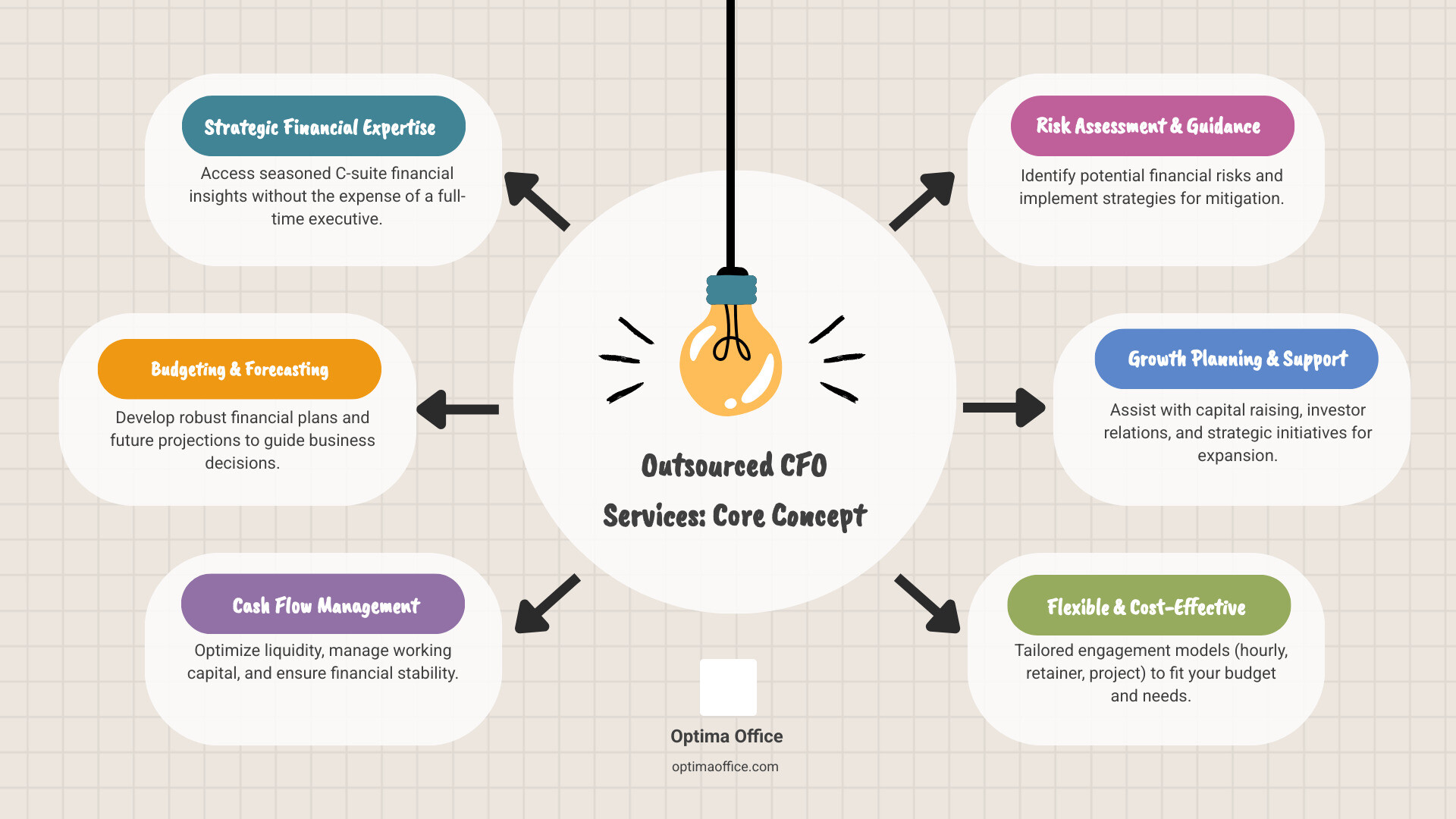
What does an outsourced CFO do for a business facing volatile growth, opaque cash flow, or an upcoming capital event? outsourced cfo company delivers strategic financial leadership on a flexible basis—translating messy day-to-day numbers into a disciplined, forward-looking financial operating system. For busy founders, CEOs, and growth-stage owners, an outsourced CFO solves the urgent problems of cash predictability, investor readiness, scalable reporting, and capital strategy while building repeatable processes that keep those problems from returning.
Below is a detailed, practitioner-focused guide that treats each area of an outsourced CFO’s work as a full mini-article. Expect practical tactics, deliverables you can require, and the metrics that tell you whether a fractional finance leader is creating real value.
Core value an outsourced CFO delivers
Transitioning from day-to-day strain to strategic clarity is primarily what founders ask for. This section explains the high-level outcomes an outsourced CFO is hired to produce and the specific pains those outcomes eliminate.
From cash anxiety to controlled runway
Founders feel cash anxiety as a continuous low-grade emergency: payroll, vendor payments, and the next funding milestone loom. An outsourced CFO eliminates that chronic uncertainty by establishing a rolling 13-week cash flow forecast and a cadence of cash-management decisions. A proper forecast is not a static spreadsheet—it’s a living instrument that ties receivables, payables, payroll, capex, and fundraising events into weekly liquidity visibility. The CFO converts that forecast into action: prioritizing payables, staging collections, negotiating vendor terms, and, if required, architecting bridge financing. The result: measured decisions about hiring, marketing spend, and discounted deals rather than panic-driven shortcuts.
From ad-hoc numbers to board-ready financials
Investors and boards require consistent, auditable, and narrative-driven reporting. An outsourced CFO builds the month-end and board-pack framework that aligns the management narrative with financial reality. That means GAAP-compliant statements when required, reconciled schedules for revenue recognition and deferred revenue, and a management commentary that ties KPI movements to strategic initiatives. Investors can’t act on fog; a fractional CFO delivers clarity and credibility.
From scattered metrics to a performance dashboard
Growth companies often have many metrics—traffic, signups, demo-to-conversion rates—but not a coherent performance management system. An outsourced CFO defines the handful of leading KPIs that drive value for a specific business model (e.g., ARR, MRR, churn, LTV:CAC for SaaS) and embeds them into a dashboard with targets and variance analysis. This creates accountability: marketing and product experiments are evaluated against financial outcomes.
From tax surprises and control failures to predictable compliance
Control weaknesses create audit risk, tax surprises, and degraded investor confidence. Outsourced CFOs harden finance by installing internal controls, delegation matrices, and a clean audit trail that meet standards from bodies like the AICPA. That reduces the cost of capital and shortens diligence time during fundraising or M&A.
From tactical decisions to capital strategy
Capital strategy is not just raising money—it's choosing the right instrument, timing, and structure to preserve optionality. An outsourced CFO partners on valuation expectations, term-sheet mechanics (including familiarity with NVCA norms), dilution modeling, and lender covenant design. This keeps founders from accepting the fastest-looking offer that later constrains growth.
These elements create a composite outcome: a company that runs with fewer surprises, has cleaner financials for investors, and makes disciplined investments in growth.
Day-to-day and recurring responsibilities
Before moving into strategic projects, a fractional CFO usually stabilizes core finance operations. This section details the concrete, recurring functions they perform and the expected outputs.
Cash management and weekly liquidity processes
Weekly cash cadence includes an up-to-date rolling 13-week cash flow forecast, variance analysis, and an action log for cash measures (delay payables, accelerate collections, negotiate terms, or plan a facility draw). The outsourced CFO sets the owners of each action, escalation thresholds, and contingency triggers (for example, when cash on hand drops below 8 weeks of payroll). Deliverables: weekly cash dashboard, action log, and lender communications if applicable.
Financial planning & analysis (FP&A) and budgeting
An outsourced CFO structures the annual budget, quarterly reforecast, and scenario models that map initiatives to financial outcomes. This includes maintaining a master model linking headcount, opex, sales funnel assumptions, CAC, retention, and revenue recognition rules. Deliverables: annual budget, quarterly reforecast, at least three scenarios (base, downside, upside), and a variance dashboard that quantifies drivers of deviation.
Month-end close and quality-controlled accounting
While day-to-day bookkeeping may remain outsourced or internal, the outsourced CFO owns the month-end close calendar: reconciliations, accruals, revenue recognition, and a close checklist. Important controls include segregation of duties (payments vs. approvals), bank reconciliations, and journal-approval workflows. Deliverables: month-end P&L, balance sheet, cash flow statement, reconciliation pack, and commentary.
Board and investor reporting
Board-ready materials go beyond numbers: they tell the story. Typical deliverables include a concise board deck with financial performance, KPI deep dives, strategic risks and mitigations, and a clear ask (resources, approvals, or funding). An outsourced CFO standardizes the deck, establishes cadence, and preps presenters to ensure consistency across meetings.
Working capital optimization
For businesses with inventory or large receivable/payable cycles, working capital management is a recurring CFO task. Techniques include just-in-time inventory, supplier renegotiation, factoring receivables, and dynamic discounting. The CFO measures metrics like DSO (days sales outstanding), DPO (days payable outstanding), and inventory turnover and sets targets tied to cash objectives.
Payroll, benefits, and vendor oversight
Although execution often sits with HR or external providers, the CFO owns budget alignment and compliance for payroll and benefits. Vendor management—term negotiation, contract review, and consolidation—is an important lever to reduce fixed costs during scaling or downturns.
Strategic and transactional work
Once operational stability exists, an outsourced CFO transitions to high-leverage, episodic work that materially changes the company’s trajectory. This section outlines those strategic responsibilities and the expected outputs.
Capital strategy and fundraising execution
An outsourced CFO prepares investor-ready financials, builds the data room, runs diligence Q&A, and models dilution scenarios. They create the financial appendix that investors expect: historic performance with reconciliations, 3–5 year financial projections with sensitivities, cap table waterfall models, and use-of-proceeds plans. They also advise on instrument selection—equity vs. SAFEs vs. convertible notes vs. venture debt—and negotiate economic and governance terms using standards like the NVCA playbook.
Debt facilities and banking relationships
Debt can be a powerful lever for growth if structured correctly. The outsourced CFO sources debt options, models covenant impacts, and negotiates pricing and covenants. Deliverables: term sheet comparison, covenant stress-tests, and draw schedule aligned with cash forecasts.
Pricing, margins, and product portfolio optimization
Pricing is often under-tightened in early companies. The CFO performs profitability by product or customer cohort, identifies margin dilution, and runs pricing experiments with controlled A/B tests. In subscription models, this includes unit-economics improvement (reducing CAC, increasing gross margin, improving retention). Deliverables: price elasticity tests, margin improvement roadmap, and cohort-level P&L.
M&A, sell-side preparation, and carve-outs
For companies pursuing M&A, the outsourced CFO prepares sell-side materials, runs process diligence, and coordinates advisors. On the buy-side, the CFO leads target financial diligence, models accretion/dilution, and designs integration plans. Deliverables: bid model, target synergies plan, integration checklist, and post-close 100-day plan.
Scenario planning and enterprise risk management
Good strategy is prepared for bad outcomes. The outsourced CFO builds scenario models that stress-test revenue drivers, margin compression, and capex. They translate scenarios into contingency playbooks—hiring freezes, cost reductions, or expedited raises—so management can act quickly under stress.
Building financial infrastructure and systems
Most scaling failures are process and systems failures dressed up as market problems. An outsourced CFO builds a repeatable financial operating system that scales with the company. This section covers practical infrastructure work.
ERP and accounting system selection
Choosing the right system early avoids expensive migrations later. SaaS startups may start with QuickBooks and graduate to NetSuite or Sage Intacct as complexity rises. The CFO maps business processes (billing, revenue recognition, purchasing, payroll) to platform capabilities and recommends a phased implementation plan that minimizes disruption. Deliverables: system requirements, vendor shortlist, implementation timeline, and ROI estimate.
Automating the month-end and close
Automation reduces errors and speeds decision cycles. The CFO identifies repetitive tasks that can be automated (bank feeds, reconciliations, intercompany eliminations) and deploys tools (close checklists, workflow automation, reconciliation software). Deliverables: a compressed close calendar (target: 3–7 days for close-to-report), automated reconciliation routines, and documented reconciliations.
Process documentation and internal controls
Process maps, policy documents, and internal-control matrices reduce operational risk and facilitate audits. The CFO installs approval thresholds, vendor onboarding procedures, and a change-control process for financial models. For investor and audit readiness, they align control design with AICPA best practices.
Data architecture and reporting stack
Creating a single source of truth requires data hygiene. The CFO defines chart of accounts, reconciles sub-ledgers, and designs a reporting warehouse or BI layer. Tools like Fathom, Adaptive Insights, or custom dashboards extract KPIs from transactional systems to provide timely insights. Deliverables: unified reporting model and a self-serve dashboard for executives.
Metrics and playbooks by business model
Different business models require distinct metrics and interventions. This section gives model-specific guidance so founders know which levers matter.
SaaS and subscription businesses
Priority metrics: ARR/MRR, gross margin, logo and revenue churn, customer acquisition cost (CAC), LTV:CAC, payback period, churn cohort analysis, and net revenue retention. The outsourced CFO implements cohort tracking and a revenue-recognition policy that complies with industry standards (e.g., ASC 606 when applicable). Playbook: tighten onboarding to reduce time-to-value, run targeted upsell campaigns for expansion revenue, and redesign pricing tiers to surface higher-margin plans.
Marketplace and platform businesses
Key metrics: take rate, liquidity (time-to-transaction), gross merchandise volume (GMV), customer and supplier retention cohorts, and contribution margin per transaction. The CFO optimizes incentives, subsidization strategies for supply-side growth, and measures marketplace depth to avoid unit-economy deterioration.
eCommerce and retail
Focus metrics: gross margin after shipping and returns, inventory turnover, DSO, customer acquisition cost by channel, and lifetime value. The CFO aligns purchasing cadence with demand signals, implements dynamic pricing, and uses working-capital facilities like inventory financing where appropriate.
Professional services and agencies
Important measures: utilization rate, realization, average project margin, contract terms, and backlog. The CFO implements project profitability tracking, resource-costing models, and billing cadence that reduces unbilled receivables.
Manufacturing and supply-heavy businesses
Priorities: cost of goods sold (COGS) accuracy, capacity utilization, capital-intensity analysis, and supply chain risk. The CFO focuses on supplier diversification, hedging commodity exposure if material, and capital allocation for capacity expansion tied to demand forecasts.
Engagement models, pricing, and ROI expectations
How you contract with an outsourced CFO determines focus and incentives. This section lays out common engagement models and the ROI you should expect.
Common engagement structures
- Fractional retainer: fixed monthly fee for a set fractional commitment (e.g., 1–3 days/week). Best for steady-state operational leadership and budgeting.
- Project-based: fixed-fee scope for deliverables (fundraising, ERP implementation, sale preparation). Best for discrete one-off needs.
- Interim/full-time transition: temporary full-time placement during CEO/CFO transitions or crises.
- Success fee or equity component: partial compensation tied to fundraising success or exit outcomes. Used when cash is constrained but alignment is needed.
Pricing ranges and what you get
Pricing varies by geography, experience, and scope. Expect market ranges from a few thousand dollars per month for startup-level fractional CFOs to $20k–$40k/month for very senior, high-execution engagements in larger growth-stage companies. Project work is priced based on deliverables and risk—fundraising packages often start at $10k–$40k depending on complexity. Require clear statements of work and acceptance criteria to avoid scope creep.
How to measure ROI
ROI is both quantitative and qualitative. Quantitative measures include reduced cash burn, extended runway, improved gross margin, faster close, decreased audit fees, and better fundraising terms (higher pre-money or lower dilution). Qualitative outcomes include cleaner governance, faster decision cycles, and reduced founder time on financial minutiae. Define KPIs at kickoff: cash days saved, months of runway gained, and time-to-board readiness.
How to evaluate and choose an outsourced CFO
Finding the right outsourced CFO is a hiring exercise with high stakes. This section gives practical interview criteria, red flags, and an onboarding checklist.
Interview questions that reveal competence
- Describe a recent 13-week cash forecast you built—what changed the most, and what action followed?
- Walk me through a term-sheet negotiation where you materially improved founder outcomes.
- Explain how you would convert our current accounting system to a more scalable ERP—what’s the first 30-day plan?
- Provide examples of KPIs you put in place for companies in our industry and how those KPIs altered decisions.
Red flags
- No examples of delivering tangible outcomes (e.g., runway extension, successful close).
- Over-reliance on high-level strategy without process or systems evidence.
- Poor grasp of compliance and controls; evasiveness on GAAP, revenue recognition, or audit readiness.
- Unwillingness to provide references or case studies.
Onboarding checklist for the first 30–90 days
- First 30 days: stabilize cash, create weekly cash forecast, secure access to accounting systems and bank accounts, and produce an initial board-ready summary.
- Days 30–60: complete month-end close improvements, implement KPI dashboard, and deliver a first reforecast with scenario analysis.
- Days 60–90: finalize process documentation, present a capital strategy if needed, and deliver a 90-day operating plan tied to measurable KPIs.
Practical case examples
Short, realistic vignettes show how an outsourced CFO turns strategy into measurable outcomes.
Seed-stage SaaS preparing to raise a Series A
Situation: $1.2M ARR, inconsistent revenue recognition, and no documented cohort metrics. Action: built investor-ready financials, implemented cohort-level ARR tracking, and created a 24-month model with fundraising scenarios. Outcome: shortened diligence to two weeks, improved valuation by demonstrating 120% net revenue retention, and closed a round with acceptable dilution. Deliverables: clean historic P&L with reconciliations, 3-statement model, KPI deck, and a data room.
Growth-stage company facing a cash crunch
Situation: rapid hiring increased burn with no cash cushion; sales seasonality created receivables spikes. Action: installed weekly cash process, negotiated 60-day terms with major vendors, accelerated collections with early-payment incentives, and secured a short-term credit line. Outcome: runway extended by 4 months, prevented a hiring freeze, and improved vendor relationships. Deliverables: weekly cash forecast, vendor negotiation summary, and lender package.
eCommerce scaling internationally
Situation: expanding into Europe exposed VAT complexity and inventory mispricing. Action: implemented multi-jurisdiction financial flows, optimized pricing to absorb VAT and shipping, and introduced an inventory-financing facility. Outcome: margins recovered by 6 percentage points after pricing changes and working-capital improvements, enabling profitable expansion. Deliverables: international pricing model, VAT compliance checklist, and funding term sheet.
Concise summary and actionable next steps
When you ask what does an outsourced cfo do, the short answer is: they turn financial chaos into repeatable systems that increase runway, improve investor outcomes, and enable smarter growth decisions. The long answer is operational and strategic—covering cash forecasting, reporting, capital strategy, systems, and model-specific KPIs.
Actionable next steps:
- Immediate (days 0–7): require a current rolling 13-week cash flow forecast and a one-page cash action plan.
- Short-term (30 days): hire or engage a fractional CFO with a clear 30/60/90 plan that includes month-end stabilization and KPI dashboard implementation.
- Medium-term (60–90 days): demand investor-ready financials and a capital strategy if fundraising is planned; pick an ERP roadmap if systems are limiting growth.
- Governance checklist: require documented internal controls, a clear owner for each financial process, and biweekly financial reviews with management.
Insist on outputs, not billable hours: board-ready financials, a reliable cash forecast, and measurable KPI improvements are the minimum deliverables that demonstrate value from an outsourced CFO.